
Glass is one of the most remarkable and versatile materials ever created by humankind. It surrounds us in everyday life — in our windows, screens, bottles, and even fiber-optic cables — yet few people stop to think about how it is made or where it comes from. The story of glass is not only one of science and craftsmanship but also of innovation and transformation over thousands of years.
In this article, we explore the making of glass and take a journey through its brief but fascinating history,from ancient roots to modern industrial production.
What is Glass?
Before diving into its origins and production, it’s important to understand what glass really is. Glass is a non-crystalline, often transparent material made primarily from silica (sand). Unlike metals or crystals, glass doesn’t have a regular internal structure. This “amorphous” nature gives glass its unique properties — strength, brittleness, and clarity.
Although we typically think of glass as transparent and fragile, it can also be strong, opaque, flexible (in fibers), or even bullet-resistant when engineered correctly.
A Brief History of Glass: From Sand to Science
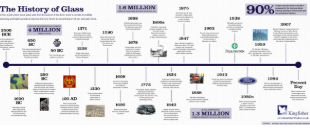
🔹 Ancient Origins (circa 3500 BCE)
The first known man-made glass objects date back over 5,000 years to Mesopotamia and ancient Egypt. Archaeological evidence suggests that early glassmaking began as an accidental byproduct of metal or ceramic production. These early pieces were often beads or small containers, not the flat panes or clear vessels we use today.
The oldest known glass artifacts, such as glass beads, were created by heating sand and soda in open fires. These pieces were crude and often opaque, but they marked the beginning of a revolutionary material.
🔹 Glass in the Roman Empire (1st Century BCE)
A major leap in glass history occurred in the Roman Empire with the invention of glassblowing around 50 BCE in the regions of Syria and Palestine. This technique allowed artisans to shape molten glass into bottles, jars, and vases using a hollow tube.
Glassblowing spread quickly across the empire, and glass became widely used in Roman households — not just for luxury but for daily practicality. Romans were among the first to produce clearer glass by adding manganese dioxide during production.
🔹 Medieval and Islamic Golden Age (7th–13th Century)
During the Islamic Golden Age, glassmakers in the Middle East significantly improved the quality and artistry of glass. Cities like Aleppo, Cairo, and Damascus became renowned for intricate designs, colored glass, and scientific tools like glass lenses and flasks.
Meanwhile, in Europe, glass production moved to Venice, where artisans on the island of Murano created some of the most beautiful and refined glass objects in history, including mirrors, chandeliers, and stained glass.
🔹 Industrial Revolution & Modern Glass (18th–20th Century)
With the advent of industrial machinery, mass production of glass became possible. In the 19th century, glass began to be used in architecture — in windows, greenhouses, and skylights. The invention of plate glass and float glass allowed for smooth, uniform sheets that we still use today.
By the 20th century, glass had become essential in science and technology. From microscope lenses to optical fibers, laboratory equipment to TV and phone screens, glass had moved far beyond simple containers or windows.
The Modern Glass-Making Process: Step by Step
Today’s glass manufacturing combines centuries-old techniques with modern technology to create strong, clear, and consistent materials. Here’s how glass is typically made:
1. Raw Materials Collection
The basic ingredients of most modern glass include:
- Silica (sand) – the primary component
- Soda ash (sodium carbonate) – lowers the melting point
- Limestone (calcium carbonate) – adds stability
- Other additives – for color, UV resistance, or clarity
These materials are mixed together in precise proportions to form what’s called a glass batch.
2. Melting the Batch
The glass batch is poured into a furnace and heated to extremely high temperatures, usually around 1700°C (3090°F). This intense heat melts the materials into a thick, molten liquid.
Melting takes several hours and is carefully controlled to ensure there are no impurities or bubbles, which can affect the quality of the final product.
3. Forming the Glass
Once melted, the molten glass is shaped using different techniques depending on the desired product:
- Float Glass Method (used for windows and flat panels): The molten glass is floated over a bed of molten tin to create a flat, even sheet.
- Blow Molding (used for bottles): A blob of molten glass is placed into a mold and blown with air to form its shape.
- Pressed Glass: Glass is pressed into molds to form plates, dishes, or decorative items.
- Drawing: Used to create long threads or fibers, such as fiber optic cables or fibreglass.
4. Annealing
After forming, the glass is slowly cooled in a process called annealing. This step helps relieve internal stresses in the material. Skipping annealing could result in the glass cracking or shattering later.
Annealing is done in a special oven called a lehr, where the glass temperature is gradually lowered over a period of time.
5. Cutting and Finishing
After cooling, the glass is cut, polished, and coated if necessary. Coatings can add UV protection, anti-glare, or heat resistance, depending on the use.
Glass for smartphones, for example, may be chemically treated to increase hardness (like Gorilla Glass), while architectural glass might be laminated or tempered for safety.
Interesting Modern Uses of Glass
In the 21st century, glass is more than just a building material. Some of the most cutting-edge innovations include:
- Smart Glass – Changes transparency with electric current
- Solar Glass – Generates electricity from sunlight
- Bulletproof Glass – Made by layering glass and polycarbonate
- Borosilicate Glass – Heat-resistant glass used in labs and cookware
- Optical Fiber – Transmits data at the speed of light
Conclusion
The journey of glass is a story of transformation — from sand on ancient shores to the high-tech innovations of today. Whether used in architecture, science, communication, or art, glass has proven to be one of the most adaptable and enduring materials in human history.
Its production process, though now modernized, still reflects the brilliance of ancient craftsmanship. And as technology continues to evolve, glass remains at the heart of innovation — a transparent bridge between the natural world and human ingenuity.